Guo Junchen
From China
Tokyo-Takadanobaba Campus
Gakushuin University
Admitted to the Department of Philosophy, Faculty of Letters
- Why did you decide to study in Japan?
- Hello, everyone. My name is Guo, and I am from Heilongjiang Province. After completing the university entrance examination in China, I came to Japan to study abroad and enrolled at ISI's Takadanobaba Campus in October 2022.
The biggest reason I chose to study in Japan was that I was encouraged by the music of the Japanese idol group Sakurazaka46 during the COVID-19 pandemic. The path they took, working hard from the time of their debut, closely resembled my own experience in high school. I was inspired by the positive message in their single “Nobody’s fault,” which encourages people to face sadness head-on.
After the university entrance examination, I was also accepted by my first-choice university in China. However, rather than waiting four years before coming to Japan for further study, I decided to seize the opportunity and study in Japan right away. - Why did you choose ISI among the many Japanese language schools?
- While searching for Japanese language schools, I came across the name ISI again and again. I learned that ISI has a high proportion of international students and brings together students from more nationalities than other schools of its kind, making it one of the most international Japanese language schools. Since I wanted to interact with students from around the world during my time abroad, I decided to enroll at ISI's Takadanobaba Campus.
- Was there a teacher who left a particularly strong impression on you during your time at ISI?
- ISI has many teachers with an international perspective. The teacher who left the strongest impression on me was Ms. Kitaguchi. She has experience living abroad and often shared stories from her own life. She had a deep understanding of the difficulties foreigners face when learning Japanese and gave us precise guidance tailored to our circumstances and needs, while teaching us natural Japanese.
We also share a common interest—baseball. After coming to Japan and being introduced to baseball, the country’s national sport, I came to enjoy watching games as well. Recently, I have also been reading the baseball manga “Star of the Giants.” Ms. Kitaguchi and I are both big fans of Shohei Ohtani, one of Japan’s most famous baseball players, and we often talk about baseball after class. - Could you tell us about your journey learning Japanese?
- I visited Japan twice when I was a child, and because I was interested in Japanese anime and manga, I began studying Japanese on my own in high school and passed the JLPT N2 while I was still in China. After attending a language school in Japan, I passed the JLPT N1 and scored 333 points on the EJU.
My Japanese studies have been driven mainly by “training my ears” and “staying interested.”
While I was in China, I searched for all kinds of resources online. After coming to Japan, I would usually leave the television on and keep Japanese programs playing no matter what I was doing. As the language gradually became familiar to my ears, my vocabulary naturally grew.
I also have many hobbies, and through each of them I can learn Japanese expressions related to that particular field.
For example, I enjoy watching documentaries, reading Japanese novels, and going to the library. I also like baseball and go to see the Yomiuri Giants play. I am interested in philosophy as well. As I developed a wide range of interests, my ability to express myself in Japanese also became richer. - Why did you want to study philosophy in Japan?
- In high school, I served as president of the debate club and also took part in a city-level competition. I understand well that philosophy helps develop critical thinking and brings a sense of intellectual joy and richness. During high school, I read philosophical works from both China and abroad, ranging from Confucianism, Buddhism, and Taoism to Plato and Socrates. I am very much looking forward to studying philosophy professionally in Japanese once I enter university.
- Could you tell us about the university you were accepted to?
- I was accepted into the Department of Philosophy in the Faculty of Letters at Gakushuin University. Gakushuin is a prestigious private university in Toshima, Tokyo, with a long history. According to the list of admitted freshmen published by the university, there were around 100 new students in my department, four of whom were international students.
- Why did you choose Gakushuin University?
- I applied only to Gakushuin University. When deciding where to apply, I visited each of the GMARCH universities. After seeing them in person, I found that Gakushuin’s campus atmosphere and location appealed to me the most.
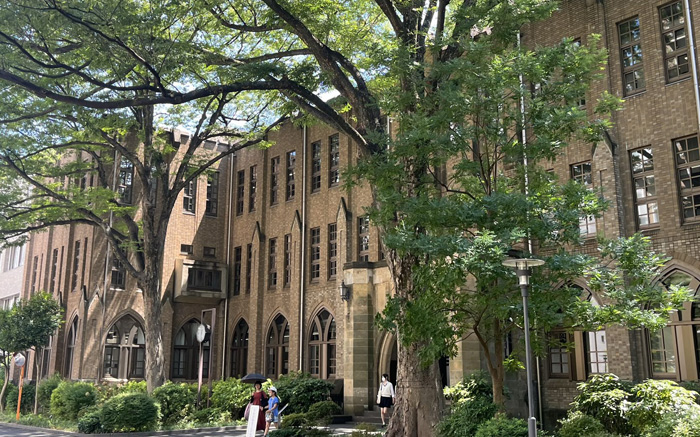
First, as a prestigious university that values tradition, the campus has many beautiful historic buildings. Gakushuin students are generally well brought up and cultured. When I visited the campus, I also noticed that the students seemed relatively calm and composed. I am the kind of person who enjoys spending time with people like that.
In addition, Gakushuin’s elementary, junior high, and high schools are located on the same campus as the university. This campus environment, where students of different ages come together, is another aspect of its diverse appeal.
Gakushuin University is also conveniently located, just a short walk from Mejiro Station.
Finally, when choosing a university, I do not place much importance on how well known it is in China or on its ranking. Unlike many Chinese students, I did not feel that I absolutely had to attend a prestigious Japanese university that everyone in China knows. - How did ISI’s university admission guidance help you with the application process?
- When I first enrolled at ISI in October 2022, I was placed in a regular class. In April of this year, I transferred to the advanced preparatory class, where all of my classmates are international students aiming to pursue higher education. Most of them are Chinese, but there are also three or four students from Europe, the United States, and other countries.
The advanced preparatory class provides highly detailed guidance for university entrance examinations. Of all the support offered, I found the interview preparation particularly effective. Many of the questions we practiced during the mock interviews were also asked in the actual interview. These included questions about a book I had recently read, why I had chosen the university and department, and whether I had any questions for the interviewers.
The school also offers mock EJU and JLPT exams as part of its exam preparation, and I took the school’s EJU mock test two or three times.
I also feel that the Japanese presentations in the Advanced Preparatory Class place particular emphasis on the accuracy of Japanese expression, including speaking ability and vocabulary. - How do you think studying abroad has changed you?
- Studying abroad has made me more independent.
In China, I lived with others, but after going abroad, I began living on my own. In China, my parents took the lead in making decisions at home, and my school took care of many things outside the home. However, after coming to Japan, I had to make every decision for myself. Spending time alone allowed me to reflect on who I am, make choices based on my own values rather than my surroundings, and become someone who can decide things independently. - Do you have any advice for students considering studying in Japan?
- Nowadays, information is available from a wide variety of sources. Whether you're researching Japan or choosing a school, I recommend gathering information from multiple sources rather than relying on just one.