ISI Japanese Language School [Official]

Quality assurance of education

We will introduce the ISI Group's comprehensive efforts towards 'quality assurance in education.'

ISI Group's efforts towards quality assurance in education.

POINT 1

Development of a unique curriculum.

We are engaged in the development of a unique curriculum and the selection and production of learning materials that meet the needs of learners and society, aiming to maximize learning effectiveness.

See more details

POINT 2

Development of excellent Japanese language teachers.

Based on the regulations of the Cultural Affairs Agency, we establish training areas and implement training according to the growth stages of teachers. We are cultivating teachers with deep knowledge and high teaching ability.

See more details

POINT 3

Implementation of a Student Satisfaction Survey

We conduct a biannual student survey to analyze satisfaction and feedback regarding the curriculum and class progress, and we engage in activities to enhance educational effectiveness.

See more details

POINT 4

Implementation of Internal Audit

Leveraging the strength of operating multiple schools, we conduct internal audits annually within the group. This allows for systematic and specialized evaluations that lead to improvements and enhancements.

See more details

POINT 5

Self-Inspection and Evaluation

We conduct self-assessment and evaluation of our educational activities and actively disclose information. We constantly impose challenges on ourselves and base our fundamental policy on autonomous and sincere efforts.

See more details

POINT 6

Evaluation certification from an external organization.

The group of four schools has obtained the international standard certification for language learning services, 'ISO29991'. They have received evaluations from external organizations, including awards from international institutions.

See more details

POINT1: Development of a unique curriculum.

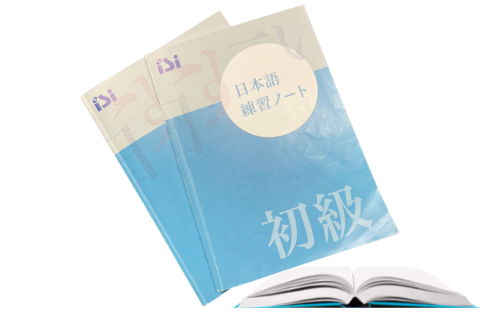
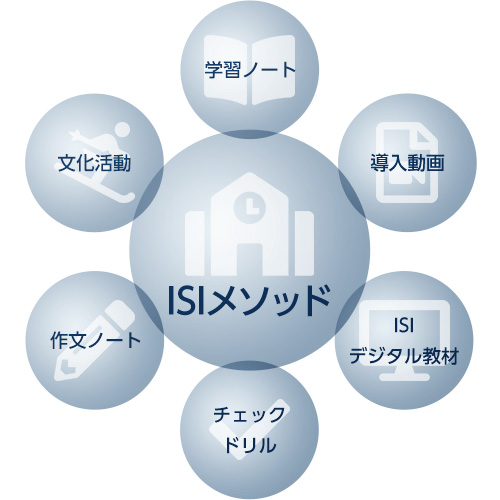
The ISI Japanese Language School Group responds to the needs of learners and society by not only focusing on classes but also capturing the entire learning process of the students. They engage in the development of a unique curriculum and the selection and production of learning materials to maximize learning outcomes.

At the beginner level, learners watch videos of familiar situations, replacing them with their own experiences to understand the day's learning objectives and stimulate their interest. The lessons actively utilize visual materials such as videos and illustrations, incorporating a lot of output practice. The classes are communication-focused, aiming for students to be able to express what they want to say, allowing them to learn in a fun atmosphere while gaining a sense of accomplishment.

Additionally, the beginner supplementary materials that enhance conversation, presentation, and writing skills, as well as the cultural understanding activity materials, are all original to ISI. They are carefully crafted by ISI's professional teachers.

POINT 2: Development of Excellent Japanese Language Teachers

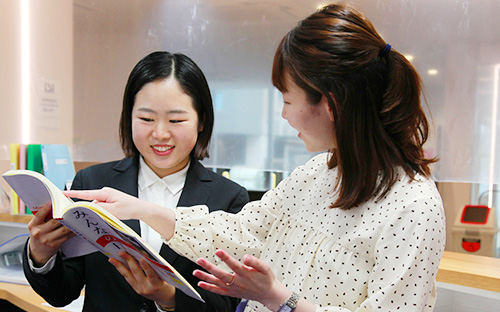
Improving the quality of education is one of the important activities in training Japanese language teachers. Therefore, at ISI, we have established training areas based on the three domains, five categories, and sixteen subcategories defined by the Agency for Cultural Affairs, and we implement a systematic educational training program based on OJT and an OFF-JT support system.
For example, we acquire the basic knowledge necessary for working in Japanese language schools and knowledge about life guidance by utilizing online training and videos. In addition, we prepare skill-up training for improving daily teaching skills, educational abilities, and career guidance abilities, tailored to the years of experience and growth stages of the teachers (ability enhancement), allowing each teacher to choose according to their needs.
We also strive to develop excellent Japanese language teachers and improve educational abilities by researching methods for skill enhancement in teaching methods and effective use of teaching materials.

Implementation of Student Satisfaction Survey.

The ISI Group conducts an annual student survey to assess satisfaction regarding the curriculum, teaching methods, faculty, and service content.
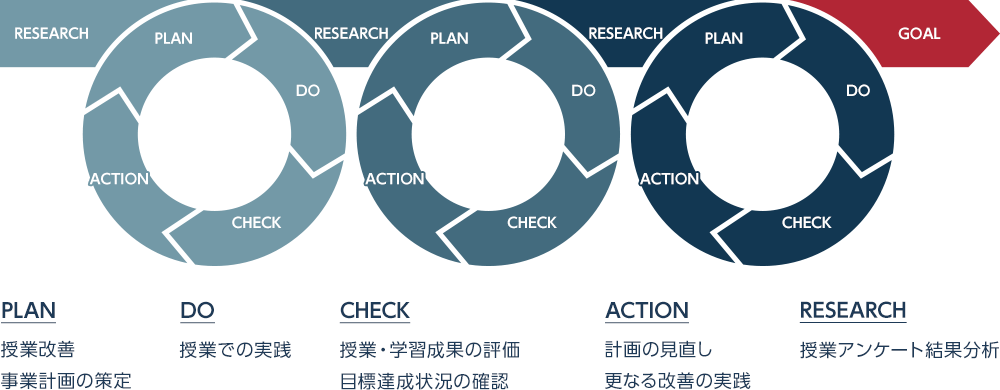
Among these, we analyze the following evaluation items related to education and engage in activities to enhance the quality of education through the R-PDCA cycle.

Overall satisfaction with ISI Japanese Language School: 77.7% (2025 survey)

Evaluation criteria related to educational content.
1 Do you understand the learning objectives of the course?
2 Are the learning objectives being achieved?
3 Are you satisfied with the structure of the curriculum?
4 Are you satisfied with the progress of the class?
5 Are you satisfied with teachers in general?
R-PDCA Cycle

Analysis of survey results and examples of improvement responses.

Regarding the improvement of teacher quality.

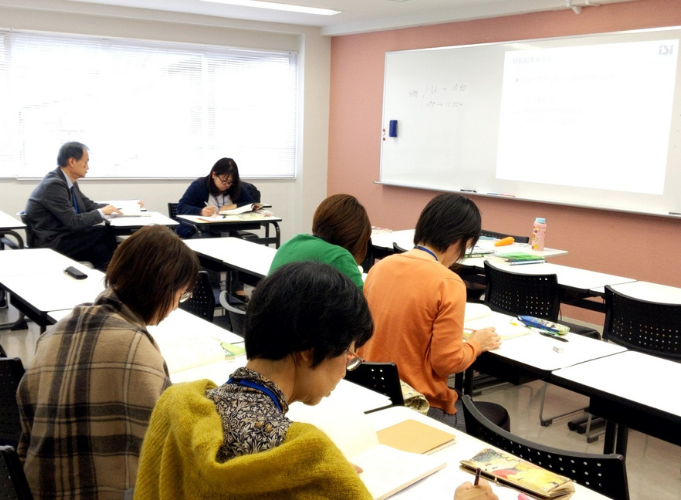
We prepare training programs that align with the growth stages of teachers (ability improvement). We are creating a system that allows each individual to select training according to their needs, aiming to enhance the quality of teacher training.

Adjustment of curriculum progress

As a result of the analysis, the necessity of listening comprehension strategies has been reaffirmed. Adjustments were made to the schedule to include practices such as shadowing (※) and exercises to listen for key points to enhance listening skills.
※Shadowing: A practice method where one reads aloud while overlaying their voice on the audio of standard Japanese speech.

POINT 4: Implementation of Internal Audit

In accordance with our ISO 29991 certification policy, we conduct internal audits as a preliminary step to external audits.
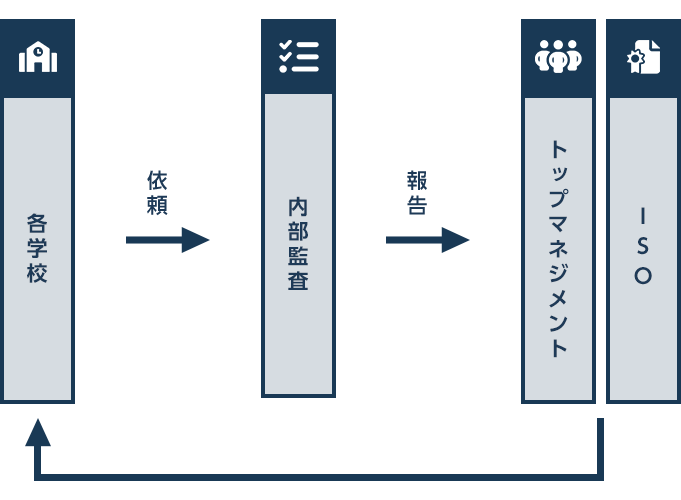
The top management, overall supervisor, and audit office are located at headquarters, while the principals and management staff of each ISI Group school serve as internal auditors. Internal auditors are appointed by the board of directors after receiving prior ISO training, and are members who do not directly handle the work but have a thorough understanding of the work.
Internal audits aim to continuously improve quality by confirming that the language learning services meet the requirements set by ISO and by reviewing the issues and improvements made since the last audit.
We conduct an annual periodic audit and a comprehensive evaluation (renewal audit) every three years, forming one cycle. The audit results are shared with top management at a briefing session, and this is used to inform the ISI Group's overall initiatives.

POINT5 Self-Inspection and Evaluation

The ISI Group aims to improve the quality of overall school operations, including education and services, by conducting self-inspections and self-evaluations at all schools every year.

Schools will consistently impose challenges on themselves, adopting autonomous and sincere efforts as their fundamental policy. They will organize 'Self-Inspection and Self-Evaluation Committees' at each school and conduct self-inspection and self-evaluation activities tailored to the structure of each department. Each school will continuously share challenges and incorporate priority issues into their business plans and activities.

The results of the 'self-inspection and self-evaluation' are published on the website, and efforts are being made to improve and reform educational research, facility enhancements, and management and organizational operations.

Self-Inspection and Evaluation Report

Fiscal Year 2025

  • *Past self-assessment and evaluation reports are published on the information disclosure page.

POINT 6: Evaluation Certification from External Organizations

Acquisition of certification for the international standard 'ISO 29991'.

"ISO29991" is a set of requirements specifically tailored for language learning service providers, aimed at improving the quality of language learning services and, consequently, enhancing customer satisfaction.
By obtaining certification, it has been recognized that the management systems of schools, learning programs, instructors, learning materials, as well as promotional activities and public relations, and the provision of information to customers meet the requirements set by international standards, and it has been evaluated that the quality of the language learning services provided maintains a high standard.

ISO29991 ISI Language School ISO29991 ISI Language School, Kyoto ISO29991 ISI Language College ISO29991 ISI Career and Language Academy, Shibuya-Harajuku ISO29991 ISI Career and Language Academy, Takadanobaba

A Japanese language school certified by international organizations, recognized for its highest standards.

The ISI Group has received certifications from numerous international organizations. At the 'Study Star Awards', known as the 'Academy Awards of the study abroad industry', we were awarded the Grand Prize (the title of Winner) as the best language education institution in terms of both quality of education and service. As a top-class language school in the world, we strive daily to provide our customers with the best service.

Award history

2011 Star Awards: SHORTLISTED (Excellence Award Winner)
2011 Star Awards: SHORTLISTED
(Awarded Excellence)
2013 Star Awards: SHORTLISTED (Excellence Award Winner)
2013 Star Awards: SHORTLISTED
(Awarded Excellence)
2014 Star Awards: SHORTLISTED (Excellence Award Winner)
2014 Star Awards: SHORTLISTED
(Awarded Excellence)
2017 Star Awards: WINNER (Grand Prize Winner)
2017 Star Awards: WINNER
(Grand Prize Winner)
2020/2021 Star Awards: FINALIST (Excellence Award Winner)
2020/2021 Star Awards: FINALIST
(Awarded Excellence)
2022 Star Awards: FINALIST (Excellence Award Recipient)
2022 Star Awards: FINALIST
(Awarded Excellence)
2023 Star Awards: FINALIST (Excellence Award Recipient)
2023 Star Awards: FINALIST
(Awarded Excellence)
2024 Star Awards: FINALIST (Excellence Award Recipient)
2024 Star Awards: FINALIST
(Awarded Excellence)
2025 Star Awards: FINALIST (received the Excellence Award)
2025 Star Awards: FINALIST
(Awarded Excellence)
2019 Excellence Award received (Takadanobaba School)
2019 Excellence Award received
(Takadanobaba Campus)